The Digital Marketing Scam Epidemic and How to Avoid It
With the job market being what it is across the United States, it’s only natural for the average person to want to expand their repertoire to make themselves more hireable. Courses that promote and promise easy money and lots of it? Even more tempting. Especially when the videos promoting such courses seem to be filled with testimonials, on accounts that have impressive follower counts.
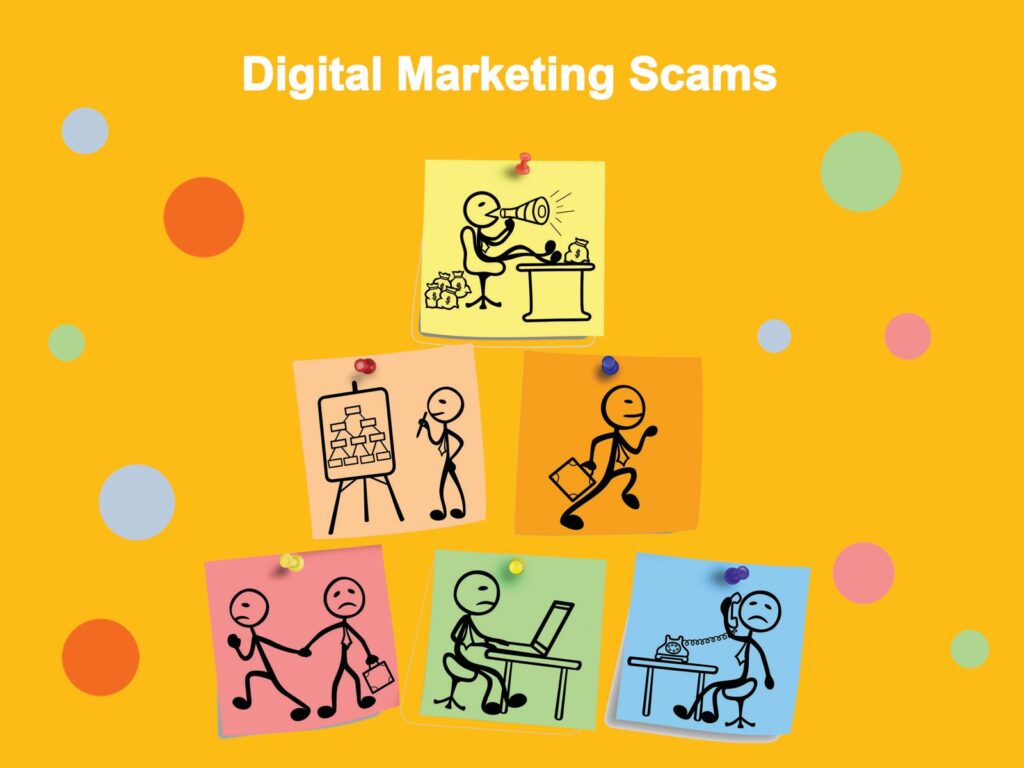
But beware, dear reader: these courses are a trap. What is pitched as a masterclass in online promotion is really a thinly veiled entryway into the bottom rung of a pyramid scheme.
Here’s how it works.
Digital marketing scams like these prey on the vulnerable. Stay-at-home mothers who want to feel like entrepreneurs. Young people who are just getting into the workforce. Those of low income who are desperate to make ends-meet on their own terms. Those who promote these digital marketing scams rave about earning “100% commission”, about how they can “set their own hours” while being financially independent.
They target buzzwords that are indicative of the social media age: digital marketing, AI, advertising. Digital marketing scams understand that pretty much everyone has to be their own marketer online in order to grow their business or make any money on social media platforms.
They’re counting on people being out of their depth and in need of a solution.
The hook is a formula. This is how they get you.
Picture this: you’re scrolling through TikTok or Instagram Reels, your thumb and your mind on autopilot. Suddenly, someone inside a car worth three times your rent is hypercutting stock footage with a motivational speech about career expansion and continued professional learning. You’re in a bit of a slump professionally, and they sound compelling, so you stop your scroll to listen.
Towards the end of the video, they tack on a link-in-bio call to action. Supposedly, that link will take you to the course that got them into that super swanky car from which they’re filming the video.
Curious, you click through, pay the enrollment fee to see what is so clearly reviewed in high regard.
What you find is not what you’d expected.
Instead of insider knowledge, you’re met with video modules, ebooks, or PDFs filled with information you, honestly, could have Googled yourself. There’s nothing valuable about marketing itself; not a word about marketing funnels, client acquisition, or advertisement strategy.
Any sort of one-on-one mentorship previously promised, sometimes called “live strategy calls”, are actually sales pitches that offer no actual expert access. Even more annoying, the “calls” in question can sometimes be pre-recorded, completely void of any personal touch.
So what are they teaching?
How to resell the very course staring back at you.
Even worse? That easy money promised to you is only obtainable through the recruitment of other people into this “course”.
It’s textbook Multi-Level Marketing. Translation: it’s a pyramid scheme.
So, how do you avoid these digital marketing scams? Look for these warning signs.
– The promotional content is incredibly flashy and focused on lifestyle: fancy cars, big houses, designer brands, but doesn’t highlight any concrete teachables regarding marketing.
– There’s a heavy influence on recruitment. Any videos you see about the course seem to be more focused on getting you to sign up than telling you what the course entails.
– The main skill taught is reselling the course, and it’s pitched as the “main skill” instead of any actual digital marketing knowledge.
– There’s no actual mentorship or access to experts in the field whatsoever after purchase. The closest thing to an “expert” you get is someone one or two rungs above entry levels whose only “teaching” revolves around the recruitment tactics mentioned above.
Keep a lookout, folks! And remember: if something online seems a little too good to be true, it probably is.